


Mobile absorber of kinetic energy when a vehicle hits a stationary or slow-moving truck, used on roads in work zones and during maintenance work

The subject of the project was a TTMA device (mobile absorber of kinetic energy when a vehicle hits a stationary or slow-moving truck, used on roads in work zones and during maintenance work).
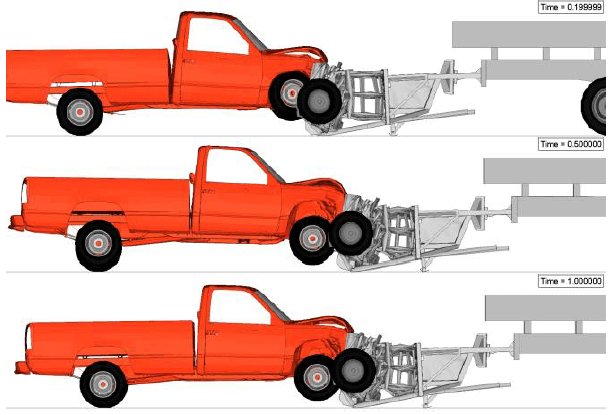

SolidWorks software was used for the design work. The numerical model of the TTMA was prepared in Altair HyperMesh. The calculations were carried out in LS-Dyna.
A prototype of the TTMA mobile absorber, meeting the requirements of European standard CEN/TS 16786:2018 for an impact speed of 100 km/h (confirmed by experimental tests).
Bus accessibility is not an afterthought but a set of requirements that influence the layout of the floor, suspension, and passenger compartment. A low entry height, space for a wheelchair, or the ability to lower the vehicle at a stop all stem from specific dimensional and functional requirements. That is why accessibility should be considered as early as the vehicle concept stage, rather than only during interior design.
Read moreCybersecurity in rolling stock has moved beyond a late-stage IT check and become a vehicle-engineering discipline. Network architecture, supplier responsibilities, software updates, secrets management and vulnerability handling all have to remain workable throughout a fleet’s service life.
Read moreRolling stock OEMs can reduce prototype risk by defining the validation scope early, connecting design with FEM analysis, checking critical joints and interfaces, and preparing traceable evidence before manufacturing begins. Simulation does not remove the need for physical testing. It helps make the prototype a confirmation of a mature design rather than the first place where major structural weaknesses are discovered.
Read more

